Kirjojen hintavertailu. Mukana 12 175 099 kirjaa ja 12 kauppaa.

Kirjailija

Upton Sinclair

Kirjat ja teokset yhdessä paikassa: 574 kirjaa, julkaisuja vuosilta 1905-2026, suosituimpien joukossa Sylvia. Vertaile teosten hintoja ja tarkista saatavuus suomalaisista kirjakaupoista.

574 kirjaa

Kirjojen julkaisuhaarukka 1905-2026.

Sonnets by Mary Craig Sinclair

Sonnets by Mary Craig Sinclair

Mary Craig Sinclair; Upton Sinclair

Literary Licensing, LLC
2013
sidottu
Sonnets By Mary Craig Sinclair is a collection of 70 sonnets written by the American author Mary Craig Sinclair. The sonnets are divided into five sections, each exploring a different theme such as love, nature, and spirituality. Sinclair's writing is characterized by its lyrical beauty and emotional depth, as she explores the complexities of the human experience through the form of the sonnet. The collection is a testament to Sinclair's skill as a poet and her ability to capture the essence of life's most profound moments in verse. Whether read for pleasure or studied for its literary merit, Sonnets By Mary Craig Sinclair is a timeless work of poetry that will resonate with readers of all ages and backgrounds.This scarce antiquarian book is a facsimile reprint of the old original and may contain some imperfections such as library marks and notations. Because we believe this work is culturally important, we have made it available as part of our commitment for protecting, preserving, and promoting the world's literature in affordable, high quality, modern editions, that are true to their original work.
Oil!

Oil!

Upton Sinclair

PENGUIN BOOKS
2007
nidottu
The classic novel that inspired the Academy award-winning film, There Will Be Blood. Penguin Books is proud to now be the sole publisher of Oil , the classic 1927 novel by Upton Sinclair. After writing The Jungle, his scathing indictment of the meatpacking industry, Sinclair turned his sights on the early days of the California oil industry in a highly entertaining story featuring a cavalcade of characters including senators, oil magnets, Hollywood film starlets, and a crusading evangelist.This lively and panoramic book, which was recently cited by David Denby in the New Yorker as being Sinclair's "most readable" novel, is now the inspiration for the Paramount Vantage major motion picture, There Will Be Blood. It is the long-awaited film from Paul Thomas Anderson, one of the most admired filmmakers working today whose previous movies, Boogie Nights and Magnolia were both multiple Academy Award nominees. The movie stars Oscar-winner Daniel Day-Lewis (Gangs of New York, My Left Foot) and Paul Dano (Little Miss Sunshine).Paramount Vantage will be releasing the film in New York and Los Angeles on December 26, 2007 and go nationwide in January. This is the same company responsible for Babel and A Mighty Heart and the current releases, Into the Wild, Margot at the Wedding, and The Kite Runner.As wars rage on in the oil region and as anxiety over natural resources rise, the subject of this book, which celebrates its 80th anniversary in 2007, is more timely than ever.
King Coal by Upton Sinclair, Fiction, Classics, Literary
A fellow determined to find the truth for himself about conditions in the mines, runs away from home and adopts the alias "Joe Smith." After being turned away by one coal mine for fear of Hal being a union organizer, he gets a job in another coal mine operated by the General Fuel Company, or GFC. In the mines he befriends many of the workers and realizes their misery and exploitation at the hands of the bosses. What he found there was abhorrent -- thus begins the tale of unionization and the advocacy workers' rights. Unionization, however, is easier spoken of than it is accomplished. It was a dangerous task -- for the leaders of the coal mines were hardened men, men who would not stop at petty threats and minor violence.Upton Sinclair is best known for writing The Jungle -- a novel that exposes the practices of the meat packing industry that lead to governmental investigations and changed food laws in America.
The Jungle by Upton Sinclair, Fiction, Classics
The book depicts working class poverty, the lack of social supports, harsh and unpleasant living and working conditions and a hopelessness among many workers. These elements are contrasted with the deeply rooted corruption of people in power. A review by the writer Jack London called it, "the Uncle Tom's Cabin of wage slavery."This is the novel that Upton Sinclair used to show horrific practices in the meatpacking industry in the first part of the twentieth century. Like most of Sinclair, the book ultimately becomes a paen to socialism. But the man could write, whatever his politics were, and ewww , the meatpackers were up to no damn good at all anyway. Highly recommended.
The Jungle

The Jungle

UPTON SINCLAIR; Anthony Arthur

Modern Library Inc
2006
pokkari
In this powerful book we enter the world of Jurgis Rudkus, a young Lithuanian immigrant who arrives in America fired with dreams of wealth, freedom, and opportunity. And we discover, with him, the astonishing truth about "packingtown," the busy, flourishing, filthy Chicago stockyards, where new world visions perish in a jungle of human suffering. Upton Sinclair, master of the "muckraking" novel, here explores the workingman's lot at the turn of the century: the backbreaking labor, the injustices of "wage-slavery," the bewildering chaos of urban life. The Jungle, a story so shocking that it launched a government investigation, recreates this startling chapter if our history in unflinching detail. Always a vigorous champion on political reform, Sinclair is also a gripping storyteller, and his 1906 novel stands as one of the most important -- and moving -- works in the literature of social change. From the Paperback edition.
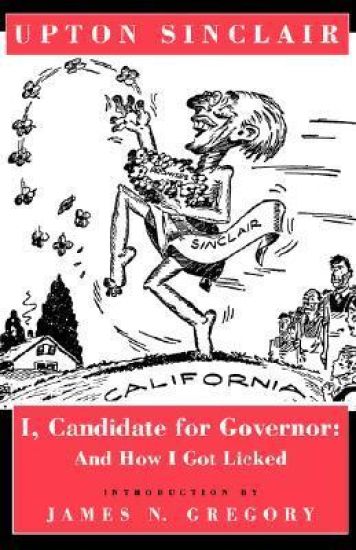
I, Candidate for Governor

I, Candidate for Governor

Upton Sinclair

University of California Press
1994
pokkari
Here, reprinted for the first time since its original publication, is muckraking journalist Upton Sinclair's lively, caustic account of the 1934 election campaign that turned California upside down and almost won him the governor's mansion. Using his 'End Poverty in California' movement (more commonly called EPIC) as a springboard, Sinclair ran for governor as a Democrat, equipped with a bold plan to end the Depression in California by taking over idle land and factories and turning them into cooperative ventures for the unemployed. To his surprise, thousands rallied to the idea, converting what he had assumed would be another of his utopian schemes into a mass political movement of extraordinary dimensions. With a loosely knit organization of hundreds of local EPIC clubs, Sinclair overwhelmed the moderate Democratic opposition to capture the primary election. When it came to the general election, however, his opposition employed highly effective campaign tactics: overwhelming media hostility, vicious red-baiting and voter intimidation, high-priced dirty tricks. The result was a resounding defeat in November. "I, Candidate" tells the story of Sinclair's campaign while also capturing the turbulent political mood of the 1930s. Employing his trademark muckraking style, Sinclair exposes the conspiracies of power that ensured big-money control over the media and other powerful institutions.